Peptide Purity Resolution Imaginative Peptides-peptide Drug Exploration
Just How To Review A Peptide Pureness Examination: Hplc, Mass Spectrometry And Coa Analysis For Uk Researchers 2026
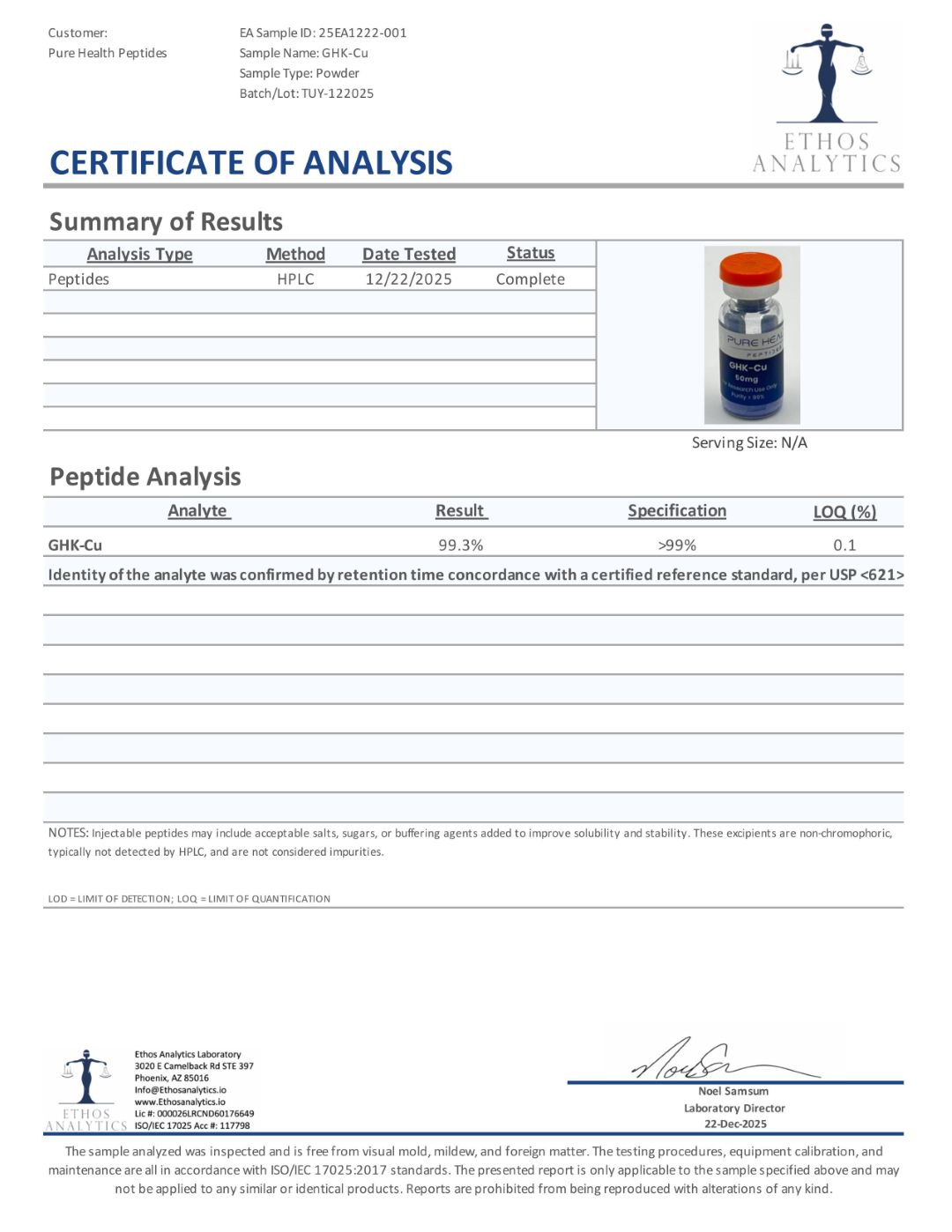
In conclusion, recognizing peptide pureness degrees and qualities aids you make educated decisions for your experiments. A peptide's pureness portion informs you just how much of that example is the actual deal versus byproducts, with typical research qualities being around 95% approximately 98-99% for added pureness. Analytical HPLC and MS are your close friends below-- HPLC evaluates purity, and MS confirms identity, with each other ensuring you understand what remains in your tube.- Peptide purity is an essential top quality metric that informs you what fraction of a peptide example is the desired product versus unwanted by-products.
- Our goal is to support researchers with high-purity, confirmed substances that satisfy the demands of modern scientific research study-- nothing more, absolutely nothing much less.
- At Maxed Out Compounds, every item we provide includes a clear testing record and clear documentation.
- It does not transform a research study substance into a clinical item, and it does not change speculative validation in the scientist's very own system.
Quality Control And Item Conformity In The Pharmaceutical Industry
While peptide pureness isn't the only aspect, making use of badly characterized reagents is an identified contributor to irreproducible results. For a 10-residue peptide with 99.5% combining performance, you 'd anticipate concerning 95% of the end product to be the full-length series prior to purification. For a 30-residue peptide at the same efficiency, that drops to approximately 86%. This is why much longer peptides are more challenging to create at high pureness and commonly cost more. Pureness is the percent of books in the delivery that have every web page printed correctly, in the right order, without missing out on phases and no added pages packed in. A 95% purity indicates that out of every 100 "books" in your batch, 95 are best duplicates and 5 have some kind of mistake.
As the percentage of natural solvent slowly boosts during the run, molecules are released from the column in order of their hydrophobicity-- the much more hydrophobic a peptide, the longer it requires to elute (wash off). Since pollutants typically vary from the target peptide by a minimum of one amino acid, they have somewhat various hydrophobicities and show up as separate peaks on the chromatogram. The bottom line is not to confuse pureness (HPLC percent of the major peptide vs impurities) with general content. For experimental preparation (like computing molar focus), both pureness and web material are useful numbers, but purity is what mirrors the chemical homogeneity of the peptide example.If the COA details "total impurities", that matches the pureness number (e.g., 98% purity indicates 2% complete contaminations). Several COAs additionally specify well-known or "defined impurities" versus undefined ones, each with their specific percents if above a particular limit. This level of information helps researchers recognize if any kind of minor peptide spin-offs exist. If you see numerous huge tops of similar elevation, you're considering Informative post either a low-purity example or a blend. If the primary optimal has a noticeable "shoulder"-- a bump on one side-- that often suggests a closely associated pollutant (like a removal peptide) that the column couldn't totally settle. The peptide is travelled through a straightforward purification action (frequently gel filtration or a quick reversed-phase cleaning) to remove salts, small-molecule by-products, and scavengers from the cleavage action.
Comprehensive Peptide High Quality Testing Services
These are important in the appropriate setting, however they need to be taken method-specific proof instead of an universal replacement for HPLC and MS. But peptide purity is perhaps the single crucial high quality metric for any kind of research peptide. It straight impacts the dependability and reproducibility of experimental outcomes. A peptide detailed at 75% pureness and one at 99% pureness aren't just different qualities-- they can generate meaningfully various end results in the exact same assay.
Encapsulation Effectiveness And Medication Loading Analysis
They are identified "for research usage just" to explain that they are planned for artificial insemination experiments or pet researches, not Quality Assurance for any kind of kind of human usage. Actually, a laboratory offering peptide screening have to provide information fulfilling the strict analytical assumptions of companies like FDA and EMA [4] By utilizing a qualified third-party lab, peptide makers or scientists ensure an impartial and skillfully documented analysis of top quality, which is precisely what inspectors seek. In addition, recurring independent testing sustains compliance in set launch and quality assurance. Research laboratory recognition for peptides suggests using clinical examinations to verify a peptide's identification, pureness, and composition. In method, this typically includes third-party or independent testing by an outside lab to confirm that a peptide product in fact contains what the tag asserts [2]Straight from the synthesizer with minimal handling-- generally simply cleavage from the resin and precipitation. Purity ranges extensively, from 40% to 80%+ depending on series size and trouble. Unrefined peptides appropriate for applications where purity isn't essential, such as antibody manufacturing or first screening assays where the target peptide just requires to be present, not dominant. Very closely related to truncations, removal peptides are unabridged chains that are missing one amino acid somewhere in the middle. If capping isn't flawlessly effective, an uncoupled chain can remain to extend in succeeding steps, creating a peptide that's just one deposit short of the target.
Each peptide has a different anticipated molecular weight, so mass confirmation is not a generic badge; it is compound-specific proof. For a much deeper identity-focused explanation, see Mass Spectrometry Peptide Confirmation. Identification testing confirms that what was synthesized is really the intended sequence.